Raspberry Pi Pico 2 Pinout
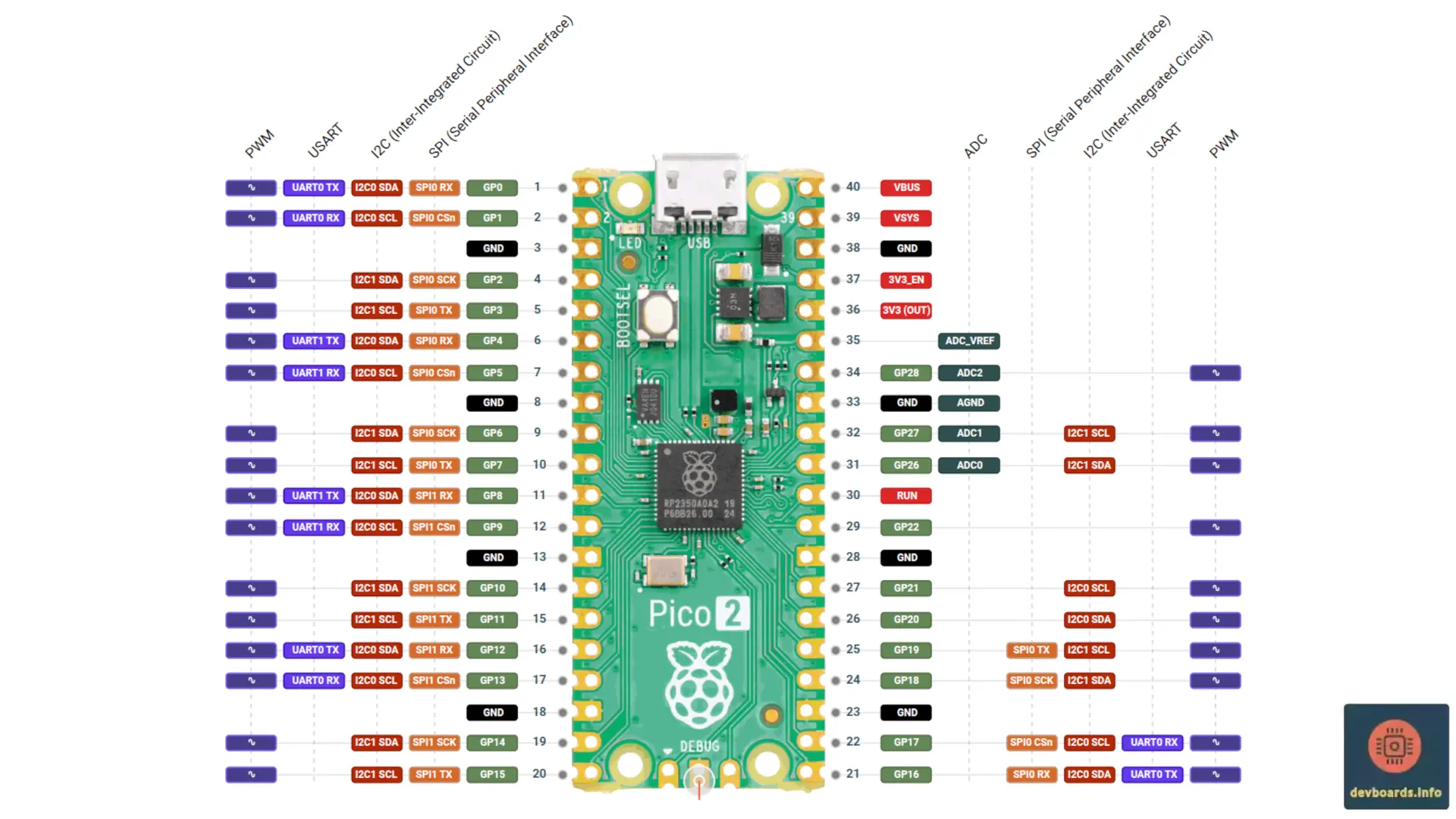
The Raspberry Pi Pico 2 is a compact and affordable microcontroller development board based on the RP2350 microcontroller. It is the successor to the popular BoardLink and provides significant improvements in processing performance, memory capacity, security features, and programmable I/O capabilities while maintaining the same small form factor and pin layout.
At the heart of the board is the RP2350 microcontroller running at up to 150 MHz. It supports either dual Arm Cortex-M33 processors or dual Hazard3 RISC-V processors, offering developers greater flexibility for embedded applications. The microcontroller is paired with 520 KB of SRAM and 4 MB of onboard QSPI flash memory for program storage.
Raspberry Pi Pico 2 pinout exposes 26 multifunction GPIO pins operating at 3.3 V logic levels. These pins can be configured for digital input and output, PWM generation, UART, SPI, I2C, ADC, and Programmable I/O (PIO) functions. Three of the GPIO pins can also be used as 12-bit analog inputs, making the board suitable for sensor interfacing and mixed-signal applications.
Raspberry Pi Pico 2 includes USB 1.1 device and host support through its Micro-USB connector, allowing the board to be programmed directly from a computer without additional hardware. The flexible power architecture supports operation from USB, external power supplies, or battery-powered systems.
One of the standout features of the RP2350 is the inclusion of three Programmable I/O (PIO) blocks with a total of twelve state machines. These programmable peripherals can be used to implement custom communication protocols and high-speed interfaces that are not supported by dedicated hardware peripherals.
The board is designed for both prototyping and production use. Its through-hole pin layout simplifies breadboard development, while the castellated edges allow it to be soldered directly onto custom PCBs as a surface-mount module.
Key features of the Raspberry Pi Pico 2 include:
- RP2350 microcontroller
- Up to 150 MHz clock frequency
- 520 KB SRAM
- 4 MB onboard QSPI flash memory
- 26 multifunction GPIO pins
- 3 ADC-capable GPIO pins with 12-bit resolution
- USB 1.1 device and host support
- 2 × UART interfaces
- 2 × SPI interfaces
- 2 × I2C interfaces
- 16 PWM channels
- 3 Programmable I/O (PIO) blocks with 12 state machines
- Flexible power supply options
- 3-pin Serial Wire Debug (SWD) interface
- Castellated module design for surface-mount integration
- Support for C, C++, MicroPython, and other development environments
Raspberry Pi Pico 2 Technical Specification
| Platform | |
|---|---|
| Manufacturer | Raspberry Pi |
| Processor | RP2350 |
| Processor Family | Arm Cortex-M33 |
| Clock Speed | 150 MHz |
| Flash Memory | 4 MB |
| SRAM | 520 KB |
| I/O | |
|---|---|
| Digital I/O | 26 |
| Analog Input | 3 |
| PWM | 16 |
| ADC Resolution | 4096 |
| Interrupts | 26 |
| Power | |
|---|---|
| Input Voltage | 5 V |
| I/O Voltage | 3.3 V |
| I/O Current | 12 mA |
| Communication Protocols | |
|---|---|
| I2C | 2x |
| SPI | 2x |
| UART | 2x |
| Connectivity | |
|---|---|
| USB Micro B | 1x USB 1.1 device or host |
| Peripherals | |
|---|---|
| Timer | 2x 64 bit |
| Watchdog Timer | 1 |
| Cryptography | Arm TrustZone for Cortex-M, signed boot, 8 kB OTP, SHA-256 acceleration, hardware TRNG |
| Debug/Trace | SWD |
| Dimensions | |
|---|---|
| Width | 21 mm |
| Length | 51 mm |
Related Development Boards
Like the Raspberry Pi Pico 2 pinout?
We publish new board pinouts every week, with interactive diagrams, specs compared, and quick-start tips. No filler, unsubscribe anytime.
Join makers and engineers who follow devboards.info